Tending to What Matters
Posted on: July 1, 2014
My heart drops. The words coming out of my father’s mouth make sense, or rather, would make sense if they were coming from anyone else. But from him, they are blasphemy.
I glance over at him, digesting what he just said, trying to form a response and it hits me how much he has changed. Gone is the stoic, granite face I’ve always known, replaced by a gaunt, wrinkled old man.
“Xeriscape?” The word is sharp and prickly as it rolls off my tongue. I try to lace my voice with confusion, with disdain, anything to cover up the quiver that is trying to expose my fear. “You want to xeriscape the yard?”
We are sitting on his front step, sipping glasses of iced tea, watching as the heat rises off the street and blurs the distant Tucson skyline. I look around me at the well-coiffed grass. Lush and luxuriant and impossibly green, it is the type of lawn you only see on landscaping brochures. But there has been no photoshopping here; just hours of meticulous, painstaking labor.
“Yeah, I’ve been thinking about it for awhile. Change is good. It keeps you young.”
He turns away from me because he is lying. Worse yet, he knows that I know he is lying--but this is what we do, this is how we communicate. We talk without talking, beating around the bush, or I guess in this case, the entire yard.
“And it’s better for the environment, too, uses a lot less water.”
This is utter bullshit; my father’s environmental ideology skews hard right. In his lifelong quest for the perfect yard, nothing was sacred, certainly not the ecosystem. Fertilizers, pesticides, ignoring city-mandated water rationing; whatever it took to have the best lawn in town, he did it, consequences to Mother Nature be damned.
I nod my head and pat him on the back.
“I gotta go, Dad. I’ve got to mow my own yard today, too. I’ll see you later, okay?”
“Alright, Jack.” He hesitates, like he wants to say something else. Instead, he shuffles into the air conditioned house. “See you later.”
***
My wife is in the kitchen unpacking groceries when I get home. I grab a beer from the six-pack she just pulled from the shopping bag. Bitter and lukewarm, it does nothing to soothe my jangled nerves.
“Hi honey, how are your parents?” she asks.
“Mom seems good. Dad’s given up on life.” I take another long drink from my beer.
“What?”
“My dad wants to rip up his entire fucking yard and put in a bunch of fucking cacti.”
“And that means he has given up on life?”
“Don’t you realize how fucking crazy that is? He loves his lawn more than most people love their children.”
“Yeah, but now you have to help him take care of it. Maybe he doesn’t want to be a burden. He’s a proud man.”
“It’s not a problem. I don’t mind helping him.”
“Did you tell him that?”
“Well, no…” I drain the last of the tepid beer and reach for another. Before I can open it my wife takes it from my hand and replaces it with a cold one from the fridge.
“That’s what I figured.” She walks out of the kitchen. “Jesus, I wish you two would learn to talk about your feelings.”
***
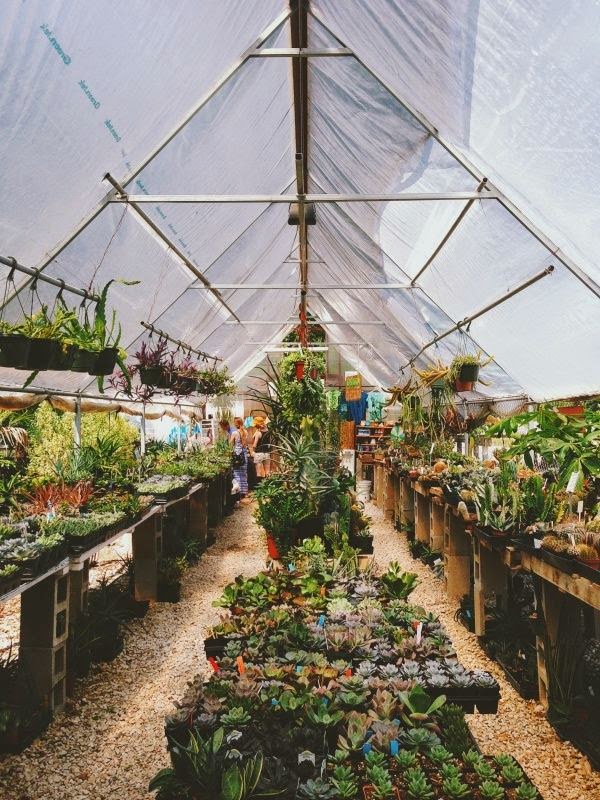
The gravel parking lot of the farmstand/greenhouse is populated mostly with Subaru Foresters and Toyota Priuses. I back my Dodge Ram into one of the last parking spots and we survey the scene. The people milling about are certainly not the big-box home improvement store demographic that we are used to.
“I didn’t know there were so many shades of khaki,” my father says, as he takes in the crowd.
He’s right. The place is crawling with aging hippie/yuppies, all clad in Birkenstocks and draped in various shades of light brown, happily carrying succulents of differing shapes and sizes back to their fuel-efficient cars.
We sit in silence and I glance in the side mirror and notice, really notice, that my dad is not the only one who has aged. My hair has become more salt, less pepper, and the lines around my eyes have deepened. I guess you can fuck over Mother Nature, but you can’t beat Father Time .
“You know Dad, you don’t have to do this. I don’t mind helping you with your yard at all.”
“Yeah, but you’re a busy man. You’ve got your own life, and your own lawn.”
“Dad,” my voice wavers as I put my hand on his arm, “I love helping you. It… it gives me a chance to hang out with you.”
He stares out the side window and clears his throat.
When he turns back to look at me, his eyes are moist. He takes a deep breath and gives my hand a squeeze. “That heart attack scared me. It made me realize that I might not have much time left.”
“Dad, don’t say that.” I can’t bring myself to look at him.
“It’s true, and sometimes you just have to face the truth. I don’t know when and I don’t know how, but I got old, Jack. I’m seventy-eight years old.” The number sinks in and he lets out a sigh. “Man, seventy-eight. Do you know how old Pop was when he died?”
“He was in his sixties wasn’t he?” I can barely speak.
“Sixty-three. And my mom was seventy-one.”
“People are living a lot longer these days Dad, and you’re in better shape than a lot of men half your age.”
“Yeah, but good shape or not, once your ticker starts to go...” he puts his hand on his chest, I see fear in his eyes.
We sit in silence, watching the people come and go. I fixate on a young father, walking with two kids, one holding each hand, a look of pure bliss on his face.
“I’ve never really contemplated life without you,” I whisper, both to him and myself.
He takes another deep breath.
“Well, I’m not gone yet, am I? And I’m not giving up. I’ve still got some living to do. I want to take your mom to Hawaii, go camping with you and Sara and the kids, hell, I might even give skydiving a whirl.”
He looks over at me and smiles.
“But I’ll tell you one thing, and it’s the truth, I’m pretty fucking sick of mowing the lawn. Come on, let’s go look at some cacti.”
Written by: Ben Cook
Photograph by: Daniel Vidal
Labels:
1:1000.
aging.
ben cook.
cacti.
cactus.
daniel vidal.
fathers and sons.
feelings.
greenhouse.
health.
heart attack.
lawn.
xeriscape.
yardwork
The Submarine Life of Cacti
Posted on: May 20, 2014
I am seeing cacti everywhere these days: an Instagram feed, foregrounding the frames of the TV show, Breaking Bad – and finally, in a sunlit glasshouse at the Phipps Conservatory, Pittsburgh. I should perhaps now amend my statement; it was after my memorable encounter with them at Phipps that I have begun to notice them everywhere.
Having explored room after room of luxuriant, almost obscenely green, tropical bushes and trees, it was somewhat a relief to encounter the cacti's austere beauty in the Conservatory's Cactus Room. And even though I had wholeheartedly admired the bonsai trees' micro perfection, the iridescent orchids, and the cocoa tree with its fat gold pods, embryonic chocolate bars nestled within them, I could not help thinking afterwards that the Cactus Room was undoubtedly my favorite one.
I wonder if it is because it appeals to my inner desert girl. Until recently, I grew up and lived in Muscat, Sultanate of Oman; the majority of its terrain is indeed a textbook dune desert, although I happened to live upon the fringes of its gravel desert. There are no cacti in Oman, but the flora is similar: minimal leaves, spare sculpted bodies, and a tenacious will to survive. Incidentally, desert also inhabits my bloodline: I belong to Rajasthan, India, which too is a desert and whose landscape does happen to be dotted with spiny, gray-green cacti. This combination of genes and happenstance probably explains my simultaneous inclination for both maximalism and minimalism; having been surrounded by minimalist landscapes, I naturally gravitate towards a pared down beauty and - yet, also occasionally and intensely crave fertile, lush bursts of color and texture.
As I roamed through the Cactus Room, I could not help but think about my first encounter with them when I was thirteen years old. It was during a pan-American trip, involving a detour through Arizona. After weeks of witnessing the glorious summer green, I felt as if I was meeting a familiar friend as the coach trundled through the desert: I thirstily absorbed the arid, fantastical wind-eroded rocks, the cerulean blue skies, and the garden of cacti. Even if the cacti themselves were unfamiliar, they looked familiar simply by the virtue of inhabiting a similar looking landscape. And in the Cactus Room, as I examined with interest this desert in miniature, admiring a succulent cheekily masquerading as a flower in bloom, I realized that these transplanted cacti had transplanted me back home...once again.
As I photographed the cacti – round and spiny, long and tapering - I idly imagined I had wandered into a fossilized ocean, the water long having receded and left behind these specimens in its wake. When I was a child, I would often go rock collecting in Oman, which is widely recognised to be a vast geological garden of sorts. As I sorted through the rocks, I would often discover ones bearing imprints of fossilized shells or plants or marine organisms: I realized that I was literally standing on an ancient sea-bed, the ocean having vanished millions of years ago as a result of plate tectonics choreography. For years, the rocks I collected accumulated in a corner of my backyard, becoming a pyramid of sorts; however, although even when my rock mania died and the pyramid disintegrated, I never forgot about those submarine fossils.
A few weeks ago, I had gone snorkeling for the first time in the waters of Florida Keys. I had swum just beneath the surface of its brilliant blue waters, cobalt blue and yellow-hued fish inches away from my face and peering down at the fecund coral garden blooming below. Growing up in Oman and regularly haunting its numerous beaches, the sea and the beach had always called out to me, defining me in a way that no landscape ever could. Even if I lived in the desert, I yearned for the sea. And yet, for all those years of frequenting the ocean, this was the first time that I had actually explored the depths of its interiors, seen and swam with its creatures and – understood it. The essence of the ocean was ultimately this submarine theater. And it was an ocean continents away that taught me that.
Standing in the Cactus Room, I felt a similar sensation to that of snorkeling beneath the ocean. After years of living in the desert, I had merely begun to see it as the desert, rather than composed of a mosaic of eccentric, intriguing characters and elements. But this is the thing about leaving home: you can only begin to define home once you have left it. Reflecting on the multiple homes that I had inhabited: Australia, India, Oman, United Kingdom and America, by way of birth or heritage or education or marriage, each journey and the subsequent new place I called home led to constant recalibrating of what home represented to me. Home, I realized, was no longer just a set of coordinates on a map: it was a sensation, elusive and ephemeral as a scent but just as palpable and memorable.
Here, in a doll-house desert transplanted in a glasshouse surrounded by an arctic Pittsburgh winter, I was conjuring up home: the desert as the ocean or vice versa. As I saw and experienced it, the two landscapes most familiar and dear to me had perfectly mashed in the cactus room at the Phipps Conservatory. As I walked around, soaking in this submarine and subterranean theater, I felt at home.
My wanderings in the Cactus Room brought me to an enormous yellow and green striped succulent and vibrantly hued, spiny cacti surrounding it. In my vision, it metamorphosed into a mutated octopus reigning over the ocean-floor: it looked as if it was in deep slumber with its sea-urchins and coral courtiers protectively guarding it. I knelt down, took its picture, and then left - lest it woke.
Photograph and Words by: Priyanka Sacheti
This work is licensed under a Creative Commons Attribution-NonCommercial-NoDerivs 3.0 Unported License
1:1000
The Design of this Blog is All rights reserved © Blog Milk Powered by Blogger