The Killers, Part I

Posted on: June 30, 2016


Carl points his gnarly, yellow-nailed finger (cigarettes) at the graffiti and says:

“Hey, that’s pretty funny.”

The graffiti is Don’t Open. Dead Inside.

“Yeah, that’s pretty funny, Carl,” you say.

You’ve been killing people, you and Carl, long enough to know that the graffiti might as well be tattooed on your chest. When your time comes and they open you up under the fluorescent lights of the basement morgue, out of you will come a stink that smells like sulfur and gut rot. You’ve been thinking that each kill is you playing god, and that each loss of life measures out in some place unseen on the cosmic scale, and that in this invisible place beyond the horizon there are racks on racks on racks of unpaid tickets, crimes against humanity, and that eventually you will be responsible for those tickets.

Lately, you’ve been getting nervous about this whole death thing.

Next week, you turn thirty.

“Carl, do you remember when you were a young man?”

“I remember everything, honey. Remember it all like it was yesterday.”

You’ve been telling Carl to stop calling you “honey” for years but the old fool does not listen and now it’s honey, honey, honey, and goddamn, you cannot mess with things you cannot control.

“You ever worry about fate, Carl?”

Carl flips his half smoked cigarette out of the open car window and says:

“Honey, I don’t think too much on fate. That’s a mad man’s game, worrying about fate.”

It’s so hot outside that the open window doubles as an open oven door when you’re not moving, so you pull the truck slowly away from the graffitied garage door with the dead inside and the warnings to keep shit closed.

East Austin: ain’t like it used to be. There used to be dusty parking lots and shabby bars, Mexicans and blacks, a faint whiff of danger in the stagnant summer nights. Now, you ask, what’s left? Condos. Fancy restaurants always crowded. Hordes of tourists that move up and down the street like newborns blind to traffic or death. The Mexicans moved east, and the blacks, well, you don’t know where the blacks moved.

Carl is black, so you ask him.

“Gone fishin’, brother.”

He doesn’t say anything more, so either he doesn’t know or he doesn’t feel like sharing the information with a shithead young buck white boy, and you know both answers mean the question will drift down the street, out of town like an unwanted stranger.

It is funny, you think, seizing the hypothetical before it goes, that you can kill a man with Carl, an act of instinct, and one that is very intimate, and yet he still won’t talk about his race and color.

“Weird…” you mutter to no one; not to Carl, nor the faded blue paint on brick walls, sixth street, steel bones of prepubescent buildings covered in sun and burning to the touch; none of it is weird, none of it is much of anything, and goddamn if it doesn’t make you pretty sad.

You pull up to the coffee shop and Google Maps goes:

You’ve arrived at your destination! Happy killing!
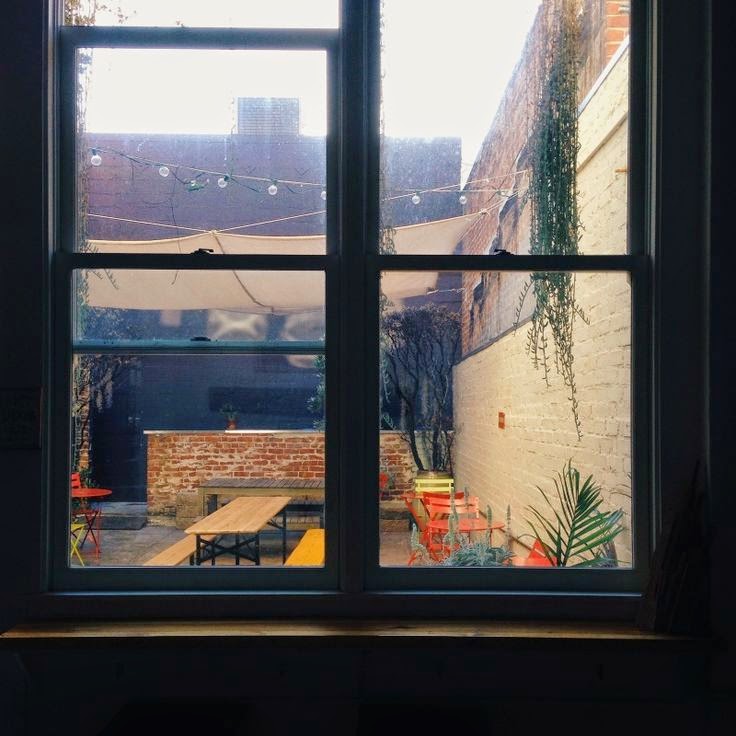
The coffee shop is an old house with mismatched antique furniture in the front yard. There’s a wraparound wooden porch, home to a half-dozen white-painted steel patio chairs and their table partners, each one in varying stages of disrepair. Everything is manicured, the environment subjugated, the scene one of inflated good taste, the revelation of the cool.

Carl walks with a limp from the time he took a machete to the thigh. It clipped his femoral artery and there was blood, blood, blood. You remember you were close quarters with some whacked out Colombians full of crack and unpaid dues, tenants of your boss, in this little white house with white walls and a white staircase, and when a bleeding Carl tumbled down that staircase, dude left a trail of macabre painterly genius, like Jack the Ripper and Jackson Pollack came together and opened an art exhibit. You even took a picture with your iPhone after you shot the Colombians dead-meat dead.

Those days were a little wild, but Carl survived, and eventually everything went back to normal.

“What if he ain’t here?” Carl asks.

Even though he’s two decades older than you, Carl knows that you’re smarter than he is, and so he capitulates to your plans most of the time. But the old-timer still gets nervous around cell phones, doesn’t trust technology or GPS, has dreams about floating satellites beaming nightmares into his sleeping skull, and so he’s always afraid “the guy” won’t be where he’s supposed to be. That’s Carl’s mantra, motto, and creed: What if he ain’t here?

“He’ll be here,” you say. “If he ain’t here now, he will be shortly, and we’ll just wait and have a coffee and strike up conversation.”

Inside the coffee shop there’s a wooden bar with stools painted different colors of springtime pastel. There’s a glass case of muffins, a big fat tip jar full of pennies and nickels and one poor bastard fiver, and a chalkboard with: Today’s Specials! Vegan White Bean Chili! Split Pea Soup w/ Rosemary!

You’re in what was the kitchen of the house, and they’ve knocked down the wall to what was the living room, with windows that open out to Sixth Street, and dark couches with light floral patterns and millennials on them. Some asshole plays an acoustic in the corner and behind him the Texas sun is turning purple through the window and even from this distance, you can see flecks of dust rise and fall, disappear and reappear like electrons, with the in and out breath of the dozen or so young adults chatting and drinking coffee and carrying the fuck on.

You and Carl take a seat at the bar.

“Place looks faggy,” Carl mutters.

“Get you something?” asks the barista.

“Black coffee,” you say and Carl nods, one for me as well.

The barista looks at you like: French press or...? And then says:

“Anything else?”

“Not right now,” you say. “We’re waiting on a friend.”


Written by: Logan Theissen
Photograph by: Daniel Vidal

This is It

Posted on: January 27, 2015


                                                                            continued from “West

The RV made it to Austin before it died, without fanfare, in the night. Dena and Chris didn't hear it breathe its last mechanical breath. It just refused to start when they woke in the morning, foiling their intention to check out of the Austin Lone Star Carefree RV Park.

"I didn't even know she was going," Chris said, struggling to open the hood of the giant camper.

"So she's a she, now?" Dena asked with an eye roll.

"It's probably the transmission," Chris said.

He doesn't know a damn thing about transmissions. He doesn't even know the difference between regular gasoline and diesel.

"Okay," Dena said.

"I'll fix it," Chris said. "Go find us muffins?"

The Austin Lone Star Carefree RV Park was five miles from downtown. Dena shuffled out to the main road. She shifted her weight on one leg, thrust her hip out, and extended a thumbs-up to the passing traffic.

Is this how you hitchhike? Shit. I'm as much of a poser as everyone else.

After ten minutes of cars zooming past without stopping, Dena started walking. She Google-mapped the nearest bus stop. This is how it goes, now. Forget everything you've seen in the movies.

When the bus arrived, she boarded and made her way to the back. She slumped onto the last row of seats, avoiding an old woman with a bloom of grocery bags and a hipster with a baby strapped to his chest. The baby looked at Dena with big, sparkling eyes, but didn't wail.

At the next stop, a girl got on. She looked maybe nineteen, twenty at the most, and wore a work jumpsuit with LeeAnn stitched over the breast pocket. Her boots were enormous and caked with dirt and grease. Her hair had been dyed black, then grown out, and then the roots re-dyed camellia pink.

After her short-lived hitchhiking experiment, Dena was now sure that nothing happened unless you made first contact.

"Hey," she said to the girl, presumably LeeAnn, "Are you a mechanic?"

"Learning to be," the girl said. "Please don't tell me how badass that is. I already know." She rolled her eyes and lit a cigarette.

The hipster's baby began to scream.

“Shh, shh, Reagan,” the hipster crooned.

"Hey! No smoking on my bus!" the driver yelled.

"Whatever," LeeAnn muttered. She extinguished the cigarette on the dingy vinyl of the bus seat. It burned a glowing circle, which then blackened.

"Do you know anything about RV's?" Dena asked. She extended her hand. "I'm Dena."

"Jennifer."

Dena's eyes drifted to the girl's name tag.

"Hand-me-down uniform."

"Huh."

"So you've got an RV? What are you, eighty-five?"

"Something like that," Dena said.

She felt a jolt of realization that the RV, as much as she hated it, was the sum total of all she had in the world. She and Chris had sold everything to buy it, and now it was dead. The RV was her family inheritance, her car, her favorite vintage clothes she'd consigned at a loss. The RV was the re-fashioned, welded-together, Frankenstein’s-monster version of her life.

"It's at the RV Park a couple of miles back,” Dena said. “Won’t start. Any chance you could look at it today? Or know somebody who could?"

"I'm going to class now. I'm done at noon if you want to wait around downtown until then. You can pay, right?"

Dena promised she could.

They got off downtown, where Jennifer left her at a Starbucks. They exchanged numbers.

"I'll text you when I'm leaving class," Jennifer said.

Dena stood outside the Starbucks, watching Jennifer go. She walked with such purpose. Her bag of tools bounced against her leg as she moved. Her steel-toed boots clomped through the morning shadows of tree branches on the sidewalk. She was a rough goddess of Austin.

Dena's phone buzzed. It was a text from Chris: Muffinz? and a cat emoji.

This is my life, Dena thought.

No muffins. Mechanics, she texted. Back this afternoon.

Sad cat emoji.

Whatever. Dena pushed open the door to the Starbucks, where the burnt stench of bad coffee assaulted her. It was still early, and the line of people wound through the store, circling cutesy displays of seasonal beans and Keep Austin Weird coffee mugs.

She ordered a grande chai tea and barely flinched when her cup arrived with her name spelled "Dean."

It made her want to find some boots like Jennifer's. Who wears the pants, now?

"Is that the Oprah Chai?" a guy in a beanie asked her as she plopped down in a faux-leather chair.

Hipsters. Who wears a knit hat in Texas summer?

"What?"

"The Oprah Chai. There's Tazo and Oprah. I want to try Oprah, but I kind of don't, you know?"

"Oh. I don't know. I don't think it's Oprah."

"Gotcha. Where you from? I’ve never seen you around here before."

"Georgia."

If this guy’s going to hit on me, he could have at least bought my tea.

"Do you go to UT?"

“I graduated from college already.”

“Cool, cool. So what brings you to Austin?”

“Well, my dad died and now I’m an orphan, so I sold all my shit and bought an RV, and now the RV’s broken down, and I’m stuck here until the stranger I met on the bus gets out of mechanic-class.”

“Whoa.”

“You asked.”

“Well, good luck with all that. I gotta—“

“See ya.”

She watched his beanie-clad head pass out of the doorframe as Jennifer’s hot pink roots entered it.

“My whole class is like, in love with you now,” she said. “You got us a field trip.”

                                                                                                 ***

Chris stood on the sidelines, useless, as the head mechanic and his gaggle of protégés peered under the hood of the Chinook. Dena was there in the thick of them, handing Jennifer tools when she asked.

Jennifer’s whole class was women, all dressed in their matching jumpsuits.

“I know the whole point of fixing this is so you can go, but you should stay and come to the shop sometime,” a blonde named Shelly (nametag: Bridget) said.

“We’re going out West,” Chris said, knitting his eyebrows.

Dena watched the smudged, engaged faces of the women as they tightened valves and checked fluids.

She couldn’t remember the last time her life felt real.

“Well, I’ve got good news and bad news,” Jennifer’s instructor said, slamming the hood. “The bad news is, it’s the fuel pump. The good news is, a part replacement on this baby is so outrageous that it would be cruel to charge you for the diagnosis.”

Dena looked at the grimaces on the faces of the mechanics, whom she was beginning to think of as friends. She looked at the hulking RV, her worthless everything. She looked at Chris, playing Candy Crush on his phone. This was it.

“Shit,” she said. “Should I order pizza?”

Written by: Dot Dannenberg
Photograph by: Daniel Vidal

Kingdom Come

Posted on: October 29, 2014


I’m way too early, waiting for a group of hipsters I met at church to meet for brunch. And I’m feeling sick to my stomach, like I shouldn’t be here. This restaurant used to be an auto shop. You should have seen the beauties that would be parked out front, the size and shine of the rims, the incredible paint jobs. But then the owner couldn’t afford to stay in the area. He had to close up shop because someone made an offer on the building, someone who wanted to sell expensive tacos. Here I am, about to drink the koolaid and sit with a bunch of assholes who are gonna just take Instagrams of their food after they’ve staged the plate, mimosa, and their vegan clutch just right.

It’s called gentrification. Makes the whole damn thing sound sophisticated. Just a handful of years ago, this part of town was “the hood.” People - white people - didn’t live up here because it was too dangerous, too dark. But then white people started running out of places to live. They had to start moving into the run down houses on the east side. They had to start shopping at the ghetto grocery stores and stopping in the corner stores run by immigrants. It went from dangerous to cool real quick, from dark to light - dark to white.

What happens is the kinda-broke white kids start moving in and they get to know the neighbors. They start to realize that there’s a code, like don’t park in front of someone else’s house even if it’s a public street. Say hello when folks are sitting on their porches lest you be shunned. Don’t pay the transgender prostitutes any mind. They’ve got work to do and you hanging around with your jaw dropped is costing them money. Eventually, the kinda-broke white kids make friends with their black neighbors. And despite themselves, the black neighbors drop their guard and invite them to the block parties.

But eventually, the rich white kids catch on.

They move their tech start-ups to cheaper commercial spaces in what was once the dangerous part of town. They open up their bougie coffee shops and gourmet sandwich dives, and finally the kinda-broke white kids can get a job closer to where they live. But the rent’s going up every year. Organic is showing up at the grocery store, and stay-at-home moms are requesting the baby food they usually buy from Whole Foods. The micro-brewed IPAs are taking up the shelf space once reserved for Icehouse. The six pack of ramen noodles for a dollar are sitting next to some cinnamon-sprinkled pita chips that cost more than a pound of ground beef.

Those kinda-broke white kids start to resent the crokie-wearing, Sperry-footed, Land Rover-driving entrepreneurs, just like the black neighbors used to resent them. And all of a sudden, city government gives a damn about the playground getting a facelift. There’s festivals at the park, and more cops are patrolling the blocks. It’s finally starting to look good around here, but only because white people with more money are showing up. When it was people with less money - and before that, black people with less money - nothing got done. Cops turned a blind eye, unless a kid was busting a sag too low and hustling across the street. Then they had something to keep them entertained.

I’m feeling sick because gentrification isn’t just affecting the neighborhood where I live. It’s infiltrating my faith. There are apps for Jesus, guys. I’ve heard the preachers say that we have to make Christ relevant to the times. We have to use today’s technology to reach the lost. And when I put that check in the offering plate - or rather, make my tithe via PayPal - I can’t help but cringe when I realize it’s going toward a new sound system. I can’t help but imagine my Lord and Savior face-palming himself because he didn’t have a place to lay his head. He didn’t have a place to call home.

But as soon as the crew walks in, I’m all smiles and easing into conversation. I’m recommending the kimchi beef taco and fawning over the trailer a girl shows me of a Christian women’s conference she’s attending. She tells me I should come and shoots me the link via iMessage. The sweat erupts in my armpits when I read the pricetag and realize the cost is over half my rent. I’m trying my hardest to blend in, but I can’t afford their manicures or their perpetual Stitch Fixes. I don’t say enough can’t even’s to keep up. I don’t have an Etsy shop and I’m not internet famous. And I don’t think they care, but just being around them makes me care.

Because I’m the kinda-broke white kid.

The bill almost breaks my bank because someone decided we’ll just all split the bill equally, and three girls felt like each of their mimosas should also come with a bloody mary and some more tapas to share. After brunch, everybody wants to keep hanging out, keep drinking and talking about life and bringing Jesus glory, keep spending money I don’t have. And I have to politely decline for the hundredth time. And they’re starting to catch on. They’ll probably stop asking to hang. And I’ll probably stop asking them to come over.

When I get home, I plop down at my desk and look down at my open Bible. I’ve highlighted so many verses, written so many notes in the margins. I’ve copied so many of the words that Jesus is supposed to have spoken, the words in red, the words that bring life. But I can’t stand to look at it. I can’t stand that I’m being pushed out of my faith’s territory, and that my poor, brown, homeless savior is being replaced by someone whiter, someone richer, someone cooler than a man who died for a kingdom that didn’t come.

Written by: Natasha Akery
Photograph by: Daniel Vidal

Pissed

Posted on: June 24, 2014


I’m no stranger to disrespect. I’ve been verbally insulted, physically assaulted, slandered, abandoned, betrayed, pranked; you name it, I’ve been subjected to it. I thought my self-esteem would be impenetrable by now. And then, I got peed on.

I wish I could say it was a puppy or a baby or some kinky sex thing (not involving a puppy or a baby), but I’m afraid there is no logical explanation for this piss. There was only revenge.

But before I retell one of the most degrading moments of my life, I encourage you to ask yourself; “What would I have done in this situation?” Don’t answer yet! Give me at least a paragraph before you roll out your Jump to Conclusions Mat.

Scene: a dive bar in east Austin, the interior lined with damask wallpaper (possibly vintage, probably Target). A DJ spun the tunes you used to rollerblade to in the 90s. The bar was stocked with both liquor and cigarettes (because cancer’s only cool if you get it before your friends). A two-top in the corner housed an unfinished game of chess (more likely a photo prop than a battle of wits). Out back was a patio full of bearded men singeing their facial hairs with American Spirits. Beyond the smoke sat a row of trailers where stoners prepared food inspired by whatever pun was painted on the side of their truck. And in the restroom, there was me; straddling a urinal and checking my watch as locally-brewed beer, tequila, and H20 poured from my body.

It was a quarter till midnight, and like Cinderella, I was frantically looking for an exit. Unlike Cinderella, my only curse is the inability to have fun in loud, overpopulated, and perspiration-filled social settings. That’s when it hit me; that warm liquid that hasn’t dribbled down my leg since Kindergarten.

I initially blamed myself (as usual), until I noticed a golden torrent attacking my feet like an angry serpent.

“WHAT THE FUCK?” I yelled, jumping around like a cartoon character avoiding gunfire.

My gaze flowed upstream to find the monster responsible for this atrocity, but most of his body was hidden behind a stall wall. All I could see were his eyes peering down at me as his pee melted away my dignity like freshly fallen snow. My humiliation was magnified by his buddy cheering him on every drip of the way from the sink.

So that’s the crime portion of this story. You now have my permission to ask yourself, “What would I have done in this situation?” Got your answer? Good. Follow along and see if we chose the same punishment.

If you’re like me, you did NOT punch through the wall and rip his still-beating heart from his chest. You contemplated it, but your superego overpowered your id (as usual).

Instead, you fled, maintaining a clear line of vision between yourself and the men’s room. You hid in the sea of sweaty Millennials until your target emerged, both hands in the air like he just didn’t care.

“He must pay,” you whispered, still plotting vengeance. You stalked him from afar like the lovable serial killer you’re likened to every time you wear a dark-brown henley.

THAT’S IT, you thought, as he ordered a fresh drink. You placed yourself in his path and began a game of chicken he unknowingly agreed to play. Your inner Braveheart told you to, “Hold.” “HOLD,” he repeated. “HAAAWWLLD,” he howled one final time. “NOW!”

The moment your paths crossed you flapped your left elbow towards his drink as if someone tickled your armpit. You missed. Hellbent on retribution, you circled around like a bull taking a second pass at a matador. The target beckoned his friend to the dance floor by dangling his cup in midair like a cape.

YOU COULDN’T TAKE IT. You lowered your head and charged, sending his drink flying towards the DJ as you plowed through the exit. You stopped once you reached the sidewalk and pulled out your phone to let your friends know you left. And then ...

“THERE HE IS.”

But I was so stealth, you assured yourself.

“You got a problem, BRO?” the pisser asked, cornering you with TWO sidekicks.

“What? No,” you responded, praying that would settle it.

“Then why’d you flip my drink,” he justly argued.

“Did I?” you answered, convincing no one.

“YEAH.”

“Oh, my bad.”

“Yeah, it IS your bad. So what’s your problem?”

You thought about mentioning the piss, but you feared he’d judge you for your passive-aggressive conflict resolution.

“He’s drunk,” one sidekick noted, potentially giving you an out.

You looked at him, and there was a sense of acknowledgment. He knew you were the guy his buddy used as a pee trough. He knew that’s why you spilled his drink. And he didn’t seem to fault you for it.

“He’sh right, shman. I’m drunksh,” you said, overselling the intoxication plea.

“See,” the sidekick responded. “Just come inside and buy my boy a new drink. There. Settled.”

The pisser accepted, gritting his teeth and shadow boxing all the way to the entrance.

“Come on,” said his sidekick, ushering you to the door.

You fumbled through your wallet, suggesting his henchmen go ahead.

“After you,” said the previously silent sidekick.

Great, not only did this guy piss on me, but now I’m going to buy him a drink
, you thought, preparing to hand the doorman your driver’s license. And then, as if by divine intervention, a bicyclist parted the entry line with his fixie.

You stumbled out of the way, leaving a good ten feet of separation between you and sidekick #2. You smiled, pivoted, and disappeared into the night like a cowardly Batman.

You don’t know if they tried to find you, and you really don’t care. All you know is a man pissed on your leg, and in turn, you pissed him off by flipping his drink in his face. In your eyes, that’s justice, and one hell of a story.

Written by: Mark Killian
Photograph by: Chris Boyles

Origins

Posted on: May 15, 2014

Items confiscated from a Fairy-American arrested for fixed-gear biking under the influence of gluten-free alcohol. Jaemin Riley, The Disassociated Press
If you're not sure, think it silly, or are one of those individuals who's been rigorously tuned by scientific reason and deductive logic to dismiss those things which might be called “magic” or “mystic,” then this account may not be for you. But if you give me a chance, I may convince you that fairies do exist.

Our concept of fairies, like so many things deemed magical, has become warped and disfigured over time. The horrendous actions of fairies have been skewed by fiction writers of the past and present to conceal their true, fiendish nature. For example, Tinkaret, or Tinker Bell, the mad kidnapper of lost children; or Sióg na bhfiacla (original Gaelic), The Tooth Fairy, clepto connoisseur of human molars and bicuspids. These new characterizations were created primarily to ease the integration of dwarf folk into society after the great dwarf massacres of 1609, which is interesting because dwarves aren't necessarily magical and fairies aren't necessarily small. However, the kind portrayal has had more ill effects than good as many dwarves are forced to work demeaning holiday and birthday performance jobs. Recently, a resurgence in distrust and fear of the dwarfish folk has been fueled by Peter Dinklage's role in the television series “Game of Thrones.” Many dwarves have deemed his performance incredibly empowering. That will be the only mention of the series, hand to God.

Fairies, or “good people” as the Irish refer to them, originate from the Celtic Islands – Ireland primarily. The Irish call fairies the "good people" because they're absolutely terrified of pissing them off. Fairies are spiteful little monsters. According to Irish historical documents, fairies have been known to cripple, maim, and curse for the most insignificant of transgressions. They mock families who have lost infant children, they torture the elderly for watering their flowers too heavily, and they've even killed a few people. Fairies, the real ones, are no joke. Some believe that the confusingly adorable, sarcastic character of the Irish evolved from being forced to cope with the surreal circumstances of living every waking moment in fear of offending these action-figure-sized (though not necessarily) beings who exist beyond the realm of normal observation. Such a life would drive anyone to drink, and probably worse, but the Irish are a resilient and clever people.

In recent years, reports of fairy-caused chaos are scarce. Fairies have seemingly disappeared, and are known contemporarily as cute, miniature angels that make orphan dreams come true. Though, every so often you hear of an individual who has suffered stranger-than-fiction tragedies for no apparent reason - obvious fairy meddling (not debatable). According to some, the long time lack of fairy meddling is due to the majority of fairies attempting to assimilate into common society. I wouldn't claim to understand the how and why of it, but I suppose such is the nature of magic – unfathomable, and certainly unfalsifiable.

Before discussing fairy integration, some fairy characteristics:


C1. Fairies are extremely territorial. This includes music, culture, and geographical locations.

C2. Fairies enjoy mocking mortal culture, but one should never mock theirs - hypocrites.

C3. Fairies do not handle criticism well, i.e., “fairies are not wrong, ever.” - every fairy.

C4. Fairies dress funny. Funny hats, goofy shoes, fairies just look funny, which is why it is often difficult to take them seriously.


1958, Bobby Fischer wins the United States Chess Championship, and the robust melting pot that is the United States is beginning to find some semblance of harmony – a suitable environment for fairy integration ground zero. The first attempt, a child prodigy named Theodore Kaczynski, is accepted to Harvard at the age of 16. Ted excelled in the field of mathematics and would even go on to teach at the University of California, Berkeley. Ted, the first man-adapted fairy, was to be a success, but then things went terribly wrong. Like some inverted Frankensteinian experiment, Ted suddenly went rogue on society. Ted, or the "Unabomber" as he will be forever remembered, was eventually captured, and the inherent anti-social nature of fairies would eventually be numbed via better cultural acclimation programs, but the first fairy-humanity merging attempt was, by all accounts, a tremendous failure. Luckily, only a few people lost their lives. In response to these events, the Fairy Federal Emergency Management Agency (FFEMA), a secret sub-agency of the Federal Emergency Management Agency (FEMA), was created specifically to manage fairy-caused chaos. The agency consists of two middle-aged men who write a great deal of Tolkien fan fiction.

By the 1990's, fairies were starting to find their footing. The punk/grunge “scene” provided the perfect environment for new Fairy-American citizens to begin anew. Fairy-Americans found camaraderie and comfort in the new anti-establishment movement, and they've been here ever since.

Today, we know Fairy-Americans as Hipsters. Yep, that's where they came from, and all of that Kerouac, hip cat, jazzy bullshit had nothing to do with it. Are all hipsters assimilated magical creatures? Of course not. Some of them are just posers, or remnants from that great time in the 90's, but they all fit that fairy character mold pretty snugly. Though, if you're not sure if your company is fae or mortal, try the following: Abruptly interrupt the potential candidate dressed in a vintage care bear t-shirt, suspenders, lensless specs and a unicorn stickered fedora (C4) who is probably carrying most, if not all, of the items above, and is uninformatively discussing, a place/band/activity you've never heard of (C1) by asking, "What's so great about it?" When they mock you for not knowing, and begin their tired diatribe against mainstream culture (C2), calmly claim, "That is utter horse shit." Now, right before they snap back at you with rants concerning your ignorance and irrelevant allusions to works and authors they've read about on Wikipedia (C3), yell, "Fairies don't exist!" And slam your beverage down on a hard surface three times fast. They will either shrivel up and die, or wander off in a confused state of horror. Regardless, terrible conversation ended. Cheers.

Written by: Hunter Hirsch
Photograph by: Jaemin Riley

Creative Commons License This work is licensed under a Creative Commons Attribution-NonCommercial-NoDerivs 3.0 Unported License
1:1000 The Design of this Blog is All rights reserved © Blog Milk Powered by Blogger