Portia's Suitor

Posted on: June 2, 2015


We made love with the taste of wine and olives on our tongues. We made love the way new couples do, pretending to be something we no longer were. It was careful and pretty, untainted by the ugly laziness that comes from years of togetherness. I liked to be on top, hair cascading across my breasts; he held me with his arms flexed, hands massaging me. He teased that I could only cum with a pillow over my face, and I laughed from behind my cotton fortress until my giggles turned to moans, then shivers.

Three weeks we had in Italy. Three weeks to save our relationship. Three weeks of romance and adventure, to spice things up.

Three of the longest weeks of my life.

It wasn't that he was always ogling the Italian women. That was understandable, I couldn't stop gawking myself. They danced across cobblestone streets in stiletto heels, impervious to the heat, navigating heart stopping traffic circles with graceful aggression. I fumbled my way around, tripping over my own blistered feet.

I also wasn't surprised by his behavior in the museums. I knew he wouldn't appreciate the treasures of antiquity. He would stand in front of a Botticelli just long enough to read the title, checking it off a mental list of things he had seen, without bothering to actually look.

I knew he would be a jerk to the locals, so I was prepared for his arguments. I hid my face behind my map while he hollered about the fact that the Italian economy depended on tourism and they should value him and his money. It always came back to money.

I expected all of those things. What surprised me, what murdered our dying relationship, was his drinking.

I learned quickly not to suggest guided tours; those all lingered too much for his tastes, delaying his reunion with the bottle. He flew through the Coliseum in a mad dash, suggesting we sit down for a "bevi" the second we made it to the exit. Who the fuck says bevi anyway? He always used cutesy words like that, trying to make it seem like no big deal.

“Time for a drinky-poo babe?” I was in the land of Chianti, Grappa, Sambuca, and it all tasted like vinegar sitting across from an alcoholic. I suffered through the vacation committed to a silent strike of sobriety. I realized that this relationship would end the instant our tires touched tarmac back home.

As the trip drew to a close, we descended on Venice. We had three nights in the city before catching a train back to Rome for our flight home. On our last night, with our bags stowed safely in a locker at the train station, we travelled to the island of Burano. There wasn't much there--handwoven lace and fishing boats against a backdrop of brightly painted buildings. He sat sipping cocktails in the warm August sun while I watched.

“How great has this been, babe?”

“Italy is beautiful.”

“I know how to take care of my girl.”

He said it with such swagger in his voice, forgetting I had paid my own way. The desperate need to distract myself coupled with the lure of the electric orange Campari coaxing me, I leaned full tilt into the bender I knew he wanted.

We eventually stumbled down to a restaurant, ripe with smells of garlic and anchovies. We ate a feast of clams and pasta, port and parmesan, and of course, buckets full of red wine. When we were done the restaurant manager rented us a room upstairs. It wasn't much--an ancient bed, a miniature sink, and a toilet.

In the quiet of our shabby hideaway, our bodies collided. I knew it was our last time together, a pleasure usually reserved for firsts. I put him to work, giving myself over to him with uncommon laziness. I let him smear me across the well-used mattress, his tongue pushed through my petal folds. It stroked, smooth and methodical, like a mother cat cleansing the fur of a kitten. I wanted him to have the tongue of a snake; quick stabs, tasting me, smelling me, and deciding to swallow me whole. When I came, it was without my usual pillow shield, and he followed soon after, before collapsing in a heap on top of me.

We lay like that, in a hot, tangled mess, watching Italian phone sex commercials until we fell asleep. I woke up hours later in the dark room, bile rising thick and bitter in the back of my throat. The darkness was complete, my head was pounding, and the unfamiliar room made my poles spin. Naked and drunk, I stumbled around in a useless panic before suddenly and violently vomiting on the floor.

It was a spectacular puke. A heroic puke. When I had finally purged the contents of my stomach, I searched for a light. I flicked the switch and as my eyes adjusted to the glow, relief gave way to fresh horror. With all the empty floor space in our spartan room, my vomit had landed squarely on my own clothing. I tried, unsuccessfully, to wash them in the tiny sink, peeling red-wine-soaked clams off the fabric, and rinsing the Campari orange noodles down the drain. None of it was salvageable, not my clothing, socks, or underwear. I threw the whole pile in the trash and cried in bed till morning.

In the morning, I remained useless in bed while he scoured the town for supplies, returning hours later with a very tight, very short, green lace gown. Clad in my skimpy lace disaster, we made it to the ferry in time. We sat waiting to leave, when I realized I’d forgotten my passport. If this ferry left without us, we might miss our flight home. The idea that I could be stuck here, for even one extra day in relationship purgatory, horrified me. With the end in sight, I ran through the tourist-clogged streets like I have never run before or since. I cut through carefully posed photo shoots, I knocked over chubby-cheeked German children, I hurdled a man in a wheelchair. I ran in all my puke-breathed, bare-bottomed, green-laced glory and somehow, with passport in hand, I made it back to the ferry and out of Italy.

I've never been back, and likely never will, but if you ever make it to Burano, I recommend you try the fettuccine alla vongole.

Written by: Sarah Scott
Photograph by: Sophie Stuart

1:1 - Jennifer Stevens

Posted on: May 28, 2015

Interviewed by Dot Dannenberg
Jennifer Stevens rocks. 

This week, 1:1000 chats with the photographer behind "The Jam Times", "Living the Dream", and "Silent Treatment" about art, skulking around abandoned buildings, and her work as a community organizer with the nonprofit Girls Rock Charleston.

1:1000: When did you first get into photography?

JENNIFER STEVENS: I’ve been taking photographs since I was a kid. My parents were always proponents for traveling, and we made sure to document EVERY trip we took. I remember cranking up my disposable camera, snapping shots every chance I had--at least, until I ran out of exposures. I still enjoy shooting with disposable cameras from time to time. I’d say that I started taking photography more seriously once I was finished with college. My undergraduate degree is in Visual Communication, and the program combined photojournalism with graphic design. I wouldn’t say that I felt prepared to make a living off of photography once I graduated. It’s a passion of mine, so I’ve always found ways to incorporate it in my life. Even now, I work full-time in an unrelated field but continue taking photographs, because it’s a form of creative expression that I strongly relate to.

1:1000: I could not be trusted with those disposable cameras as a kid--I’d end up with a roll of 24 photos of my thumb. Disposable cameras seem like a lot of work now, though. What are your thoughts on the Instagram age we live in, where every 16-year-old with an iPhone is calling themselves a photographer?

JS: There’s a quote that says the best camera is the one you have with you. I have mixed feelings about this particular question. Generally, I think it’s really great that more and more people are able to document their lives and experiences. I mean, I love being able to see what my friends are seeing/experiencing all over the world. What makes one person’s image on Instagram any less valuable than a photograph hanging up in a museum?

1:1000: That quote resonates with me so much. I know tons of people who have fancy DSLRs that never leave the camera bag. What's your favorite photo you've taken so far?

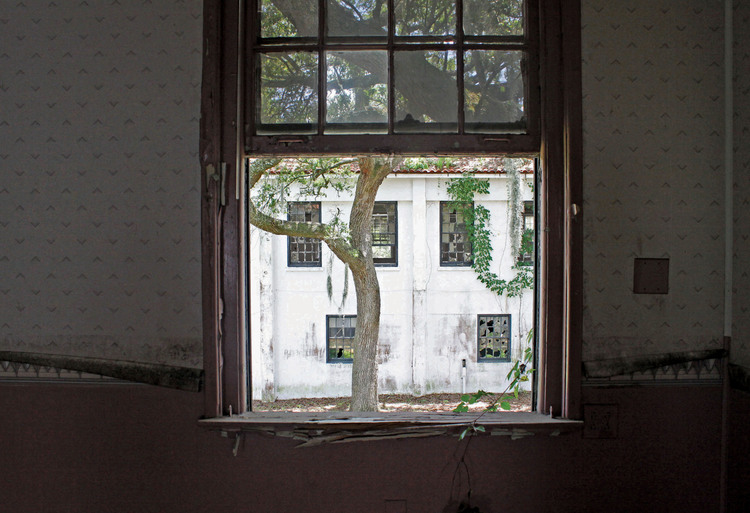
JS: My current favorite photograph is one I took inside an abandoned Navy building in 2013--it’s titled Abandoned I. The former Navy shipyard has now become a mixed-use area for the city of North Charleston called The Navy Yard at Noisette. There are still remnants of the old shipyard, including a handful of abandoned military facilities. I have a favorite building there, and I have gone back a couple of times to document the interior and exterior of the facility.

Abandoned I
1:1000: What do you think draws you to these subjects that have such an unconventional beauty--abandoned buildings, chipped paint, rust?

JS: I’ve always been drawn to things that display unconventional beauty. I mean, beauty is so subjective anyway. Abandoned, dilapidated, and sometimes forgotten spaces appeal to me in a way that more modern, well-kept, and well-known spaces don’t. It’s fascinating to think about the story behind these spaces, these things - how did they get to be in the condition they’re in? Who occupied the space? These are questions I often ask myself when documenting buildings.

1:1000: And that, I think, is where the fun really starts for the writers who work from your photos.

JS: I definitely see my work relating to issues like gentrification and also sustainability. Some of my work was recently featured in Synergies--a regional sustainability publication put out by the College of Charleston Office of Sustainability.

1:1000: Who are your favorite photographers right now?

JS: Two of my favorite photographers are Kate Wichlinski and Chloe Gilstrap. Kate is a dear friend of mine whom I met in Charleston a few years ago. She has since moved to New York...When you view her work, you really feel a connection to Kate and her subjects (she also makes these wonderful self-portraits). Chloe is another photographer that I really admire. I also met her in Charleston a few years ago. Similar to Kate, Chloe has since moved away from Charleston (she’s living in Seattle now)...She’s extremely talented and uses various printing techniques.

1:1000: What's the process been like watching writers interpret your photos for 1:1000? It’s jarring for me, even now, learning that the photo that served as a setting for Morgan Ira James’s “The Jam Times” was actually a military facility.

JS: I think it’s quite fascinating, really. It’s interesting to see how my work is being interpreted. I try to put myself in the shoes of the writer and realize that I would probably interpret the photographs in a completely different way. But that’s what makes it truly interesting--how we each have our own interpretation of things. It’s also flattering to have someone create a story based on a certain emotion or emotions that were provoked when viewing one of my photographs. I appreciate being featured!

1:1000: What else should we know about Jen Stevens?

JS: Besides travel and photography, I’m really passionate about volunteering and non-profit work. I’m an organizer with a grassroots, social justice organization called Girls Rock Charleston. Our mission is to empower girls and transgender youth through music education, DIY media, and creative collaboration. We offer a one-week day camp for girls and transgender youth ages 9 to 17. At camp, participants take instrument instruction in drums, guitar, keys, or bass, form bands, and write and rehearse original songs that are played live at an end-of-camp showcase event. In addition to music education, the campers attend workshops that range from topics such as art and resistance and DIY media, to DJing and self-defense. While our programs involve music, we focus less on instruction and more on music as a means for personal and social change.

1:1000: That sounds awesome. What kind of change do you see in the kids?

JS: We have campers who show up on day one of camp week with little or no experience playing music. We help provide the tools and space to enable them--it's really remarkable to see how much confidence they gain throughout the week. They end up doing things they didn't know were possible--especially when they rock out with their bands on showcase day. Our campers are so great, and I feel so inspired by them to continue doing this work. I think it's much needed in the Charleston community.

1:1000: What mantras are you living by lately?

JS: Excellent question! I have a few mantras that I am living by lately:
Travel as much as possible. Some of the most enjoyable experiences in my life have been because of travel - the people I’ve met, the things I have seen, the activities I have been able to experience.

Only do what only you can do. This is especially true for me since I tend to say “yes” to most things.

Be open to change.
We are all unique and view/approach situations in a different way. I feel
like it’s best to be open to different viewpoints, open to new experiences, and open to changing our own perspective on things.

Silent Treatment

Posted on: May 26, 2015


Read the rest of the "West" saga: Part 1 | Part 2 | Part 3 | Part 4 | Part 5

Outside Dena’s window, the desert flew past in a never-ending loop. Sandy ground. Scruffy shrub. Discarded tire. Sandy ground. Scruffy shrub. Discarded beer can. Sandy ground...

It was like watching one of the GIFs Chris loved so much. The cat swats the wine glass off the table, and then looks at the videographer and seems to grin. The video loops, re-sets, and the wine is back. The cat prepares its paw to swat.

“Would you be happier if I’d stayed in Austin?” Dena asked.

Chris’s gaze locked on the road, as focused as if he were navigating switchback mountain passes instead of keeping a straight line for hundreds of miles. Dena noticed his jaw clench.

“I just think if you’re never going to talk to me again--” she started.

“Jesus, Dena. Can you just give me some time? If I say what I’m thinking right now, I’m going to regret it.”

The first words in a six-hour silent treatment.

“Maybe I deserve it, though,” Dena said.

“Oh, you definitely do.”

Chris rummaged between his seat and the center console for his aviators.

Okay, so cry. And hide it, Dena thought. She tried to envision what she’d do if their roles were reversed--if she’d walked into a clearing expecting to find a party, and instead found her boyfriend half naked with some guy.

The problem was, she knew exactly what she’d do. She’d laugh.

Dena had felt so numb for so long. Her father’s death had shut off her normal reactions. When she’d climbed into the RV with Chris ten days ago, she’d felt almost inhuman. But in the field with Jennifer--she’d caught her breath, just for a second.

She fiddled with the radio.

--a Connecticut pastor drops dead in front of his congregation after confessing to an extramarital affair. More on this story when we come--

Dena punched the radio back off.

So she had cheated. So what. It wasn’t like they were engaged. And it wasn’t like she’d expected to stay in Austin to be with Jennifer. To don a jumpsuit and fix cars and play second mommy to Jennifer’s kid? Shit. Jennifer’s kid. That had thrown Dena for a loop. There was so much she hadn’t known. Everyone, herself included, was a stranger.

If only Chris hadn’t shown up. She could have gotten tipsy at the bonfire, kissed Jennifer one more time, and then gone with her boyfriend in the morning. She could have left town as Chris’s partner in crime and Jennifer’s mysterious what-might-have-been. Now, Dena could be neither.

“Explain this to me, though,” Chris said. “What is it, exactly, that you want?”

Now it was Dena’s turn to be silent. She tugged at the frayed hem of her shorts, twisting a thread until it broke off in her hand.

“I guess I wanted to feel something,” she said under her breath.

“What was that? You wanted to feel something?”

Chris took his eyes off the road and turned his face towards Dena. She could see her reflection in his sunglasses.

He jerked the wheel of the RV to the right, and they veered onto the road shoulder, before he jerked it left again. A red truck in the eastbound lane honked as they missed colliding by a few feet.

“What the fuck?” Dena said.

“Did you feel something? Did you? Did you get what you wanted?”

“Chris, don’t be a psychopath!”

“No, you don’t be a psychopath, Dena. You don’t. Because do you know what psychopaths even are? People who can’t feel anything. People who will hurt other people because to them, it feels like nothing.”

“Chris, that is not what I meant.”

“Do you even feel guilty at all?” he asked, his voice whining higher as he fought back tears.

“Yes, okay? I feel bad!”

“You feel bad you got caught,” Chris said, wiping his nose with the back of his hand.

“I shouldn’t have done it. Is that what you want me to say?” Dena said. “I don’t know what’s wrong with me. I’m going crazy or something. I don’t even like girls.”

“Yes you do, and that’s not what this is about.This isn’t some true awakening bullshit, and you know it. This is about choices, Dena.”

“Okay! Okay. It’s about choices! And right now, I am choosing to be with you. Even though you hate me more than anyone in America!”

“I don’t hate you.”

“You just tried to fucking run us off the road.”

“You tried to run us off the road. Like, metaphorically speaking.”

“You’re an idiot,” Dena said, cracking a smile.

Chris pushed his aviators up on his forehead and massaged the bridge of his nose where the glasses had pressed red, bean-shaped indentations.

“I’m starving,” Chris said. “I’m going to stop up here, and then can you maybe give me some space until we get to Santa Fe?”

“Okay.”

Chris drove onto the exit ramp and followed the signs towards McDonald’s. He parked on the far side of the lot and opened his door.

“Five piece or ten-piece?” he asked, not meeting Dena’s eye.

“Ten piece.”

Dena watched Chris cross the parking lot. His hands were jammed in his pockets. She rolled down her window and leaned out. The air was hot, but dry, and smelled of sage and oily french fries. She thought about calling out after him, but couldn’t think of anything to say.

When Chris returned, Dena took her chicken nuggets and climbed up into the bed above the RV’s cab. She took tiny bites, counting how many times she could chew before swallowing, turning the meat into mush.

Chris turned the radio up full blast and drove them away from the restaurant. Dena sprawled on the bed like a starfish. She felt like a stowaway. Below her, Chris sang along with broken-hearted Taylor Swift, periodically smacking the steering wheel to accentuate the beat of universal pain.

The RV coasted down the access ramp and back onto the interstate. Dena closed her eyes and let the rumble of the desert road lull her to sleep.

Written by: Dot Dannenberg
Photograph by: Jennifer Stevens

Hanged Man

Posted on: May 21, 2015


Continued from Three of Swords

I try to hold the sun inside the same way your mother did, like a talisman. I see her squeezing that ball of light so tight that it oozed over every inch of your childhood home; an aura of habitual happiness.

I kept your old dresser from 2nd St. and now it’s painted like Lemon Meringue. I know you’d hate it. But Shaw doesn’t seem to mind. He leaves little things for me to find: yellow pieces of paper with other people’s song lyrics, daffodils in wine bottles emptied the night before. He wants them to speak sweet things to me when he can’t write the words himself.

This morning we find each other in silence, watching the sunrise.

“It’s lovely,” I say. But the way that gold glitters reminds me how you’d always quote that book to explain tragedy. The guilt tastes like dust now, so dry and decayed. It makes me think about the moment of evaporation and dehydration; the moment a person becomes a husk.

Shaw drinks his coffee from a tall green mug. I stare until it blurs and quakes and sprouts like grass. When I blink, it’s the color of your eyes. But Shaw doesn’t look into the dark surface of his coffee like you did. His eyes bring me back.

“Just a few hours there and home later tonight,” I say, taking a sip of his coffee.

“Stay,” Shaw says. I know he means it like a promise, not a command. I smile and kiss him on the cheek. I don’t ask him to come with me. A new cd starts playing when I start the car and I look up at Shaw on the balcony. When he waves and smiles, I know he knows I’ve found his new mix.

From the interstate, the green exit signs remind me how close I am to you. It has been two years since we were here together. I remember that last time, the dark sky tinged with lights from the city; acid washed. I wore your old Syracuse University sweatshirt with the hole in the left sleeve, wrapped up in your dreams.

When I pull into the parking lot, the sky is bright and the breeze is cool. I wish I still had your sweatshirt now. But standing in front of St. Paul’s Episcopal Church, I fall in line with everyone else. The church is old, built from beautiful stones, and the burdens of sinners. I stay to the left to avoid the arms of those I know best.

“May we be blessed in remembering,” the priest says.

You grab my hand and lead me from the churchyard, distancing us from headstones and mourners. Smoke dances as you light a cigarette, trying to tweak the tines of my shipwrecked soul; a petite pallograph.

“Tell me a story?” I ask and you smile.

“Lost my first tooth in first grade and it was brilliant. Really, it was,” you say. “I was chewing a cherry gum ball and it happened just like that, just like us.” You kiss me and I bite your lip to stop you. But I taste metallic bits, drinking you in to bring myself back to life.

“Look at them all,” you say. I’m not sure if you mean the people surrounding that distant grave or the tiny blue flowers that grow in this part of the cemetery. They make me think of that summer we spent blanketed in blue, surrounded by sky and chicory blossoms; believing in perfection. Because you were perfect then, even if you didn’t know it. Moss eyes. Dusk hair. Skin like spiced vinegar. You reminded me of the earth and the beginning of time.

“There’s falling from stupid shit,” you say. “Like bike seats and bed frames and billiard tables. And then, there’s this.”

“I know, Jess.”

You don’t need to tell me about the way you love me. I see it in the way you pick up a penny and flip it luck-side up in my hand. I squeeze it tight, trying to absorb you.

“Just in case,” you say. I know what you mean, even if I don’t say it back. For the moment, you are made of stories and secrets and simple things. You are mine again. This time, when you kiss me, I let you. Our lips crush the distance of the last two years. We are closer than we ever were.

“Nothing gold,” I say when you pull away.

“It’s already happened.”

“But what about us? What about falling? What about—”

I imagine you explaining in a letter, maybe writing through the back of my black dress: Love. You. Can’t. Couldn’t. Me. Sorry. Love. Love. Love. But you leave because you were never one for words.

I walk back for the rest of the service. They lower your body into the earth and they pray: ashes to ashes, dust to dust. I make the sign of the cross. The memories fade, and with them, so do you.

Your mother stands beside your casket, so soft, ready to melt. She bears the marks of loss in tired eyes and slumped shoulders. She talks about the way you used to swing from boyhood branches and I taste her guilt like mine; pure and pungent. I think about what I would say to her, praying that a tight-lipped I’m sorry might grow to encompass everything I felt for you. But I know I am not the person your mother wants to hear those words from.

I call Shaw from the car. I wait for him to pick up the phone. You whisper, I miss you, from the backseat.

“He’s gone, you know? And I wrote this fucking thing, this letter, for him, and didn’t even read it. So he won’t know, because I never sent it. I--”

“I’m sure he knew, Gray,” Shaw says.

But I don’t. The not knowing fills the space between the three of us equilaterally.

“I wrote you something,” he says.

Shaw recites his haiku over and over like the chorus of a song:

Light burns from gold to
silver. It can’t stay. But I’ll
seal you in stardust.

On my way back to your grave, I fold the letter until I can’t anymore. I send my thoughts somewhere gold so they won’t live inside me. I leave them here with you.

Written by: Kayla King
Photograph by: Erin Notarthomas

Some Farm

Posted on: May 19, 2015


When the woman came to paint the farm, I didn’t know what to say, so I asked her if she would like to come in.

She wore a white, crocheted shawl about her shoulders and a colorful bandana in her hair. She had light eyes, blue or green, and a green sweater over a pale pink dress. It was a warm day for early April in Hoosick, the day after Easter, and she arrived as pleasantly and unexpectedly as the warm day had.

“I looked out my window and saw your farm, and I have canvas and acrylics in the car. Would you mind if I set up across the road and try to paint the property?”

I hesitated, at first not understanding what she was asking. I looked past her to the blue Volvo station wagon, where a crystal dangling from the rearview mirror winked back at me. She must have mistaken my pause for reluctance because in my silence she said, “There’s a strip of dead land between your crops that runs along your farm, and from the road it looks like a river.”

“The land’s not dead,” I said. “That’s just where we cut the corn.”

“It’s one of the loveliest, most unexpected sights I’ve ever seen,” she said.

“You’re welcome to paint it. Is there anything I can get for you?”

“I’d love a piece of charcoal, actually,” she said. “If you have it. And some water, if you’d be so kind.”

“You’ll want a chair to sit in, I imagine,” I said. I went to the deck and put a couple of pieces of charcoal into a brown paper bag and got a hard-backed chair from the office. I went to the kitchen and filled a jar with water. She waited in the doorway.

“Would you care to come in a moment? I’m just about to have breakfast if you’re hungry.” She came in and said no thank you. I offered her a glass of water.

“Just for the paints,” she said. I gave the jar to her, and she thanked me.

“Restroom’s first door on your right here, just come on in any time you need to.” I brought the chair out to her car.

“Oh,” she said. “Would you mind if I left my car here?”

“Not at all,” I said. “You want me to drive you over?”

She turned to look at the world behind us.

“You’re very kind, but I’d like the walk. I’ll bring the chair across the road myself,” she said.

“Let me help,” I said. I rarely walked to the road any more. I was almost always in the truck.

“Thank you. I don’t mean to put you out,” she said.

We went on down the drive, a two-person caravan. She didn’t have to stop once to adjust the way she carried her canvas, acrylics, cups, water and brushes. She had perfectly balanced all of it, or she was supernaturally determined not to waste a minute of sunlight, or both. I set the chair down across the road, ending our procession where the Wilsons’ trash bins usually waited for collection.

“Cars come by awful fast, you know,” I said. She smiled as if to respond, Not much we can do about that, can we? She sat down in the chair.

“Perfect,” she said. We were both a little short of breath. She put the canvas in her lap and supplies by her feet. We looked at the land. I think I saw what she meant by the land looking like a river, though I can’t say for sure. “This quality of light is just beautiful,” she said. It was. Looking at the farm from where she sat, the barns stood both out of and a part of the land. It would make for a fine painting, I thought.

“It’s funny. You saying the land between crops looks like a river. From here you can’t see it over the corn, but there’s a real creek, you know. We passed it coming up the drive.”

“Yes,” she said politely but without much interest. It occurred to me that she didn’t plan to paint the land, but the land as she saw it. She had taken one of the lumps of charcoal from the bag and began streaking it across the canvas, looking alternately between the canvas and the land, creating something that was neither.

“If you need anything, just start to walk back. I’ll drive out to meet you.”

“Yes,” she said. “Thank you so much. This is just wonderful. Please, enjoy your breakfast.” She was trying, it seemed, to look meaningfully at me when she thanked me, trying to make sure I understood her gratitude, but the scene had hypnotized her. I reckoned there wasn’t any form of gratitude more evident than her intense pursuit of the work before her.

“All right now. I’ll keep an eye out,” I told her. She hummed in response. As I crossed the road, walked down the drive, past the creek, and up to the house, I felt something like an usher at the movie theaters walking in front of the screen. Down in front, I imagined the woman thinking, wanting popcorn to throw at me. As I walked to the porch, I became acutely aware that I was somehow between and a part of the landscape and the woman’s rendering of it.

After a few hours on the tractor, I walked back up the drive with some water.

“For the painter.” I said. She laughed.

“Thank you. My paints aren’t thirsty yet, but I am,” she set down the nub of coal and canvas and stood, accepting the jar with blackened hands. She stepped away, drinking and looking. “My, what a day,” she said. The canvas was charcoal all over, rough smears and delicate, grainy shading, thumb-smudged adjustments. It looked unlike any farm I had ever seen.

Story and Photograph by: Matt Briggs

The Violent Acts of Poets, Part II

Posted on: May 14, 2015


Lily Miller’s daddy was a trashman who blew up his trailer. He was inside when it went kaboom, and there were bits of him scattered around his trailer’s acre lot. The little pieces looked like confetti. Lee Miller was his name, and he ended up nothing more than bits of candy from a busted pinata. RIP, Lee Miller.

To supplement his trash income, he cooked. Chicken cutlets. Microwave dinners from the blue box. Spaghetti O’s. Eventually, meth. He wore a goalie mask when he did it, white with holes like Jason Voorhees, and wrapped a wet towel around his nose and mouth. I told him he was missing the point, and he cackled and drank his High Life. He fancied himself a king when he opened a High Life, and there was no getting him to listen to nothing.

Lily hadn’t been round him much growing up, her mother knew better than that. But my pops, Eli, and him grew up together in Kingfisher. I remember them sitting on upturned painter’s buckets, smoking menthols, and passing a bottle of Jim Beam some nights. This was before my father died. He was an alright man, Lee Miller. Some folks are only what they are, and he was one of those. Nothing wrong with being what you are, my father used to say.

It was after Lee Miller’s trailer exploded that our troubles began in earnest. Dead men pay no debts, unfortunately, and it’s up to the living to keep on surviving.

                                                                                                ***

I let Lily sleep in the back seat when the morning came, even though it was cold. I just covered her a bit more under the blanket and kissed her forehead. Her bruises were dark getting darker. Like the night had bumped into her and rubbed off some of its neverending black, and now she was branded.

By the time I got to the convict Mcalester Freeman it was clear that I had killed him the night before. I didn’t know his name until later of course, but even nameless he couldn’t get much in the way of sympathy from me. His face was grey and blue like a Lacy dog’s coat. The whites of his stuck eyes saturated yellow.

I broke some mesquite branches, and with bloody hands covered him up best I could. There was a chill, and it stuck to the back of my neck while I plowed the earth with my fingers. It struck me that I had gone nearly twenty years of life without killing a soul. And now, two of em’ in the less than forty-eight hours. Goddamn.

When I’d done all I could do with the body, I began to pray over it. But I couldn’t concentrate right, gave it up halfway through, and went to wake Lily who was sleeping soft and kind.

                                                                                                ***

We went as far as we could until the gas hand ticked like a broken clock against empty. Lily and I goaded the fumes and pushed ourselves forward in the cab hoping for a few more rolls of the wheels. We succeeded and stalled out in gas station ruins. There was a broken car half-eaten up with rust and a sign on the store window advertising antiques.

I told Lily to get the revolver from the glove compartment, and she did, and she weighed it in her palm. She held it careful as an egg, said it was cold and heavy. Then she said, we ain’t got nothing. We got bruises, I told her. Bruises, health, and our gun. There’s money in antiques, she said before opening the door and unfolding herself, stepping outside holding the gun under the blanket wrapped around her.

I asked her what she was doing and she came around the car to me and stuck the revolver in the back of her jeans. She took off the blanket and draped it around me before kissing me and telling me that she loved me no matter what. No matter if the cops found us and burned us both. I told her that nobody would be burning nobody, but she didn’t say nothing and just looked back at the antiques store. Before she opened the door and I heard that bell ring, the one that sometimes comes with opening doors, she reached behind her and grabbed the gun.

When she came out she wasn’t hurrying, only carrying a brown paper grocery sack like she was bringing her lunch. I asked her what happened and she said that she had a big sack of money, that’s what happened. I asked her for the gun and she handed it over. It was still cold and heavy.

She pulled keys from her pocket and dangled them. The proprietor has an old truck out back, she said, so we went around and I saw the crimson truck the color of rust with white-walled wheels. The white-walls belonged to an earlier time. Maybe one where meth trailers didn’t blow up, where thugs didn’t threaten young girls for the sins of their fathers, where boys didn’t have to turn to men so soon, and where the laws of God and man rode side by side like brothers, instead of fighting like wild cats, twisting and bumping and snarling at one another.

We drove dead north keeping off the interstate as much as we could. I knew the cops wouldn’t figure it was us until they found Lily’s car with the license plates. I asked her if the cashier was gonna be calling the cops and she shook her head. She was driving and didn’t look over at me. Why not? I asked. It ain’t a problem, baby, she said. She was chewing bubble gum, wearing cutoff jean shorts. The frays, the little cotton tendrils, pressed up against her thigh, reminded me of jellyfish all washed up on shore with something dead about them. I don’t know why, but she made me think of the ocean sometimes, and I imagined us walking barefoot like everyone else along the rim of the sea.

It got dark somewhere in Nebraska and I took over driving. Lily fell asleep snoring with her legs across my lap, and the bracelet on her wrist tapped against the window like drunken code. A town blinked away in the distance, each light a firefly caught in the whirling purple clouds of the central shelf. A storm’s coming, I said to no one. Soon we dipped into a valley and the lights disappeared.

Written by: Logan Theissen
Photograph by: Daniel Vidal

Staying Afloat

Posted on: May 12, 2015


“What the hell happened to this place?” Jeff said, inching forward until a piece of ivy penetrated the Mercedes logo in the center of his grill.

Jeff silenced the stampeding horses beneath his hood and opened his door until the hinges squealed. He got out and did a full 360-degree turn to confirm he was the only car in sight. Once he stopped spinning he was facing a sign that was partially buried beneath several years of unattended foliage.

Jeff closed the door with the gentle care of a new parent and mashed the lock button on his keys four times to make sure his beloved Benz was secure. He walked towards the illegible letters, maintaining his balance as the uneven gravel shifted beneath his Seabagos like the sand surrounding his ocean-front property. He grabbed one of the strands of ivy and pulled it like a sail rope, but instead of righting a ship, he showered himself and his vehicle with the contents of the rain gutter.

***

The nautical bell by the entrance chimed, telling Max it was time to put away his newspaper.

“Welcome to Max’s, I mean, My Claw Trap,” he said, stowing the periodical beneath the register.

Jeff’s protruding jaw was the first thing through the door, followed by the rest of his rage-twisted face and arms that he held away from his torso to avoid spreading the sludge across his Ralph Lauren button up.

“Max?” said the scarecrow-esque silhouette standing in the sunlit doorway.

“Yes?” Max replied.

“It’s me,” the silhouette said, approaching the counter, “Jeff.”

“So it is,” Max said, hopping off his stool and heading to the order side of the sandwich bar. “What can I get for you?”

“Do you have to ask?” Jeff said, allowing his arms to emphasize his bewilderment.

“I do if you want to eat,” Max answered.

“Give me the usual,” Jeff said.

“Which is?” Max replied.

“A Lobster roll, extra lemon butter hot sauce, on a sundried tomato hoagie; just like the old days,” Jeff said.

“Can’t you get that at The Lobster Snare,” Max said, slicing the roll with a giant bread knife.

“I wish,” Jeff said, resting his forearms on top of the deli case, “but you’re a stubborn son of a bitch.”

Max continued down the assembly line without saying a word. He used his bare hands to dig through the lobster trough and pluck out the tiniest pieces of meat he could find. He zig-zagged the hot sauce so wide, more liquid ended up in the basket than it did on the sandwich.

“Chips?” Max asked.

“Of course,” Jeff responded.

Max grabbed a handful of fried potatoes and squeezed, sprinkling the shards of starch across the pond of hot sauce next to the sandwich.

“Drink?” Max asked.

“Just water,” Jeff answered.

Max took one of the styrofoam cups sitting next to the register and carried it to the hand sink behind the drink machine.

“Can I get a little ice?” Jeff asked as Max returned to the register.

“Machine’s broken,” Max said without breaking his stride. “That’ll be eleven-fifty.”

“Do you take cards yet?” Jeff said, reaching for his wallet.

“Nope,” Max said.

“It’s like you’re trying to scare away new customers,” Jeff said.

“Maybe I am,” Max replied.

“Well, you’re doing a great job at it. Between this, your ivy-covered sign, and that death trap you call a parking lot, I’m surprised you’re still in business.”

“I stay afloat,” Max said, opening the register and grabbing the crisp twenty from Jeff’s hand.

“That’s a great way to describe it,” Jeff said. “Staying afloat.”

“You want to take this to go?” Max asked.

“No, as a matter of fact, I think I’ll sit right here,” Jeff said occupying the table closest to the register.

“Suit yourself,” Max said, unfolding the newspaper and hopping back on his stool.

Jeff grabbed one of the tiny morsels of lobster meat and grinned before popping it into his mouth and letting it dissolve on his tongue.

“Good God, Max,” Jeff said. “Even at its worst, this sandwich is still better than anything we serve at my restaurants.”

“I know,” Max replied from behind his tabloid veil.

“Do you ever think of how much money you could’ve made?” Jeff asked.

“Nope,” Max responded.

“With your recipes, and my business savvy, we could’ve been the Bubba Gump of lobster.” Jeff said, followed by his final bite of sandwich. “You’d be Forrest, of course,” he continued, cheeks as round as buoys, “or maybe Bubba. Bubba was the one who knew how to cook everything.”

Jeff filled his fingers with the last of the soggy chips, tipped his head back and trickled the butter-soaked spuds into his mouth before giving his entire hand a cat bath.

“But you decided to stick with this,” Jeff said, pointing his glistening fingernails at every corner of the establishment.

“A captain doesn’t abandon his ship,” Max said, still hidden by the paper.

“Well, you could be commanding an entire fleet by now,” Jeff said, standing up from the table. “Just like me.”

“No thanks,” Max said.

“Deja vu,” Jeff said, lifting his basket from the table. “You want me to do anything with this?”

“I’ll take care of it,” Max answered.

“Don’t wait too long,” Jeff said, “Customers won’t like it. Speak of the devil!”

The nautical bell chimed and a middle-aged woman wearing jeans and a windbreaker rushed through the door.

“Max,” the woman shouted from the entrance, “I’m gonna hit the head, but I’ll take the usual.”

“You got it, Sandy,” Max said, hopping off his stool.

“Well, Max, it’s been a pleasure,” Jeff said and headed towards the door. “Stay afloat.”

“Hey Jeff,” Max said.

“Yes?” Jeff responded with one hand on the door.

“Your fleet’s looking a little lost,” Max said, holding up a full-page newspaper ad for The Lobster Snare that read, The world’s greatest lobster roll* is charting a course for your freezer.

The nautical bell chimed and Jeff disappeared.

Written by: Mark Killian
Photograph by: Daniel Vidal

Three of Swords

Posted on: May 7, 2015


The window fogs beneath my breath; a blank slate. Here I write your name. Always your name. The upholstery is not unlike that of any other train: rough and stained and seeping with other people’s secrets. This gives me a nonsensical dose of hope, leaving the taste of lemons and honey behind.

Somewhere out there you might be sitting on a train, looking out the window, thinking about me too. Maybe you smile without opening your mouth, your lips the seal of an envelope. I loved to kiss words from you this way. But maybe there is another pair of lips performing this same kind of ventriloquist act and you let her, even though it was our thing.

Maybe you tell her about that movie and you both laugh and nod and she slips her legs around you and the train moves slow and rocks you back and forth. You are in love with her, and you kiss more words into her.

“Can I sit here?”

The voice comes from a twenty­-something who slides into the seat next to me. His eyebrows are thick and his lips are full, as if every part of him is filled up with youth. He looks younger than you ever did.

“Jess?” he asks. And I look, like maybe I’m responding to my own name.

“Grace,” I say. I’m not sure why the lie slips so easily from me, except that your name is still printed on the window.

“Where you headed?”

His question makes me remember why I hated having you as a travel companion. I just want to absorb the feeling of leaving, the abundance of possibilities out there in the world; quiet.

“The beach.”

“Bit cold for that,” he says, pointing to the snow beyond the train window. “Me, I just like to ride and write. No place in mind, no place to go. Just the ride,” he says. He pulls a leather notebook from his bag and scratches a few lines onto the page.

“What’re you writing?” I ask. I don’t tell him I’m a writer, that a similar journal hides in my purse. Because when I used to talk about writing, you never said anything. You just poured cream into your coffee and smiled while stirring everything up, like maybe you were looking at the entire galaxy instead of just a cup of coffee. Instead of looking at me.

“Notes, ideas, sentences. Whatever.”

I nod and retrace the letters of your name on the window. I hear the scratching again and know he’s taken himself back to the page. I close my eyes and pretend it is the sound of waves. I imagine you with your windows open, the way they always were back home. Maybe they wrap around your new house like the symbol for infinity, window after window; forever. Or maybe they are like an ampersand now, a broken reminder that nothing lasts, that there is always an and when it all ends.

“Infinity sign or ampersand?” I ask.

“Ampersand, always. Just look at it,” he says, sketching it out on the page. It looks beautiful, like a line embracing itself. “Self-­love,” he says.

“Oh.”

“No, not like that. Like it’s just you and, whoever, whatever you want, you know?”

“Yeah, I like that.”

“So where are you really going?” he asks, his pen holding place in the notebook. I stare at the cover, trying to find the words hidden within.

“Away.” This is the first true thing I tell him, even though I don’t know his name.

“Away happens to be my favorite.”

You never said anything that perfect. Maybe you are better with words now that I am gone. And maybe the phrases you give her blossom into beautiful sentiments because they have filled you with something new.

“I’ll just call you Away, then,” I say.

“It’s Shaw.”

I smile at the way he says his name, like it is the most precious thing he owns. “Mine’s Grayson,” I say, letting another truth pass over my lips.

“So, you hate your name?”

“Ah, no, actually. But—”

“No, wait, let me guess,” he says, turning in his seat so he faces me. From this angle his vintage-­style tee looks shabbier beneath his jacket; well­-loved. An image of a baby cherub peeks at me with eyes like his, round and grey. “You hate your dad? Or mom? Or your ex hated the name? Or you like to lie to strangers? Must be getting close,” he says.

“Are you speaking from experience?”

“Doesn’t everyone?”

He pulls out an iPod and hands me an earbud. We sit like that for too many miles, the landscape zipping by in a collage of greens: dill and meadow and sea mist and cabbage. They remind me of your eyes until I look back at Shaw. He mouths the words to the acoustic song that blares through the headphones.

“Indigo dawn,” he says out loud, no longer lip syncing.

Soon the song ends and he finds another and closes his eyes. I write Shaw’s name in stiff, sword-­like letters on the window before adding my own. I pull my journal from my bag and write indigo dawn and same sun, a partial lyric from the current song. I make them into a story and when I look up, Shaw is watching me write. And then he kisses me, and he tastes like cigarettes and gin.

When the train stops, Shaw grabs my hand, and leads me out into the station. He pulls a joint from his pocket and we smoke and kiss beneath the sign to Fairfield where no one can see us. He traces the back of my neck and I feel the word writer.

If you looked through that train window now, all you would see is a pair of empty seats and the remnants of names criss­-crossing the glass like constellations. And maybe that is the way it should be.

Written by: Kayla King
Photograph by: Samuel Zeller

Touch of Grey

Posted on: May 5, 2015


I glance at the stack of messages my secretary just handed me. The name on the top one hits me like knuckles to the solar plexus.

“Are you okay?” she asks.

I stare at the name, scrawled in her barely legible scribble. Walt Bowman.

“Mr. Willett?” Her voice wavers. “Did I do something wrong?”

I shift my gaze to her. She’s a temp, but besides her poor handwriting, she has been doing a fantastic job. Sadly, this makes her one of the few bright spots of my life at the moment. I do my best to regain my composure.

“No, Darlene, you didn’t do anything wrong.” I try to smile at her to put her at ease.

“Whew, you had me scared there for a minute.” She lets out a nervous laugh. I know she needs this job as much as I need some sort of stability in my life right now. She puts her hand on my arm, a warm grandmotherly touch. “I know I shouldn’t pry, but is it something to do with the divorce? I know how hard it can be.”

I shake my head and hold up the message.

“No, this is just a name I haven’t seen in a long, long time. It’s probably just a coincidence anyway, I’m sure it’s not even the same guy I used to know.”

I close the door to my office and think about the first time I saw Walt Bowman. In his torn jeans and ragged Grateful Dead t-shirt, all eyes were on him as he came sauntering through the door of Ms. Faber’s freshman English class. As he searched for a seat, he scoured the class, taking in all the Beverly Hills 90210 clones in their Z Cavaricci jeans and Oxford shirts. And then he spied me, sitting in the corner, about as non-descript as you could get.

“What’s up, I’m Walt,” he said, sliding into the desk next to me.

“Eric,” I replied.

“You like to get high Eric?” he asked, eyebrows raised, a pimply grin spreading across his face.

“Uhh…” I glanced around the room, full of kids that I had known most of my life, but who seemed to have forgotten my name through the years. I thought of my mother and the look of quiet sadness she would get whenever she asked why I never invite any friends over after school. I turned to Walt, and tried to sound as cool as possible. “Yeah, I love to get high, who doesn’t?”

“Good,” he said.

My God, Walt fucking Bowman.

I notice my fingers tremble a little as I punch the numbers into the phone. My heart beats faster with each ring.

“Hello?” My stomach drops, the voice doesn’t sound familiar at all.

“Is this Walt Bowman? My name is Eric Willett.”

“Eric! How are you doing? You remember me, right? Hayward High, freshman year?”

“Of course I remember you. I just never expected to talk to you again. What happened to you? You just disappeared.”

“Yeah, sorry about that.” He chuckles. “My dad was pretty mad when the cops brought me home. He moved us to Albany to live with my grandparents.” He chuckles again. “Man, what were we thinking?”

Thinking? I remember us thinking Spring Break warranted something more exciting than sneaking a half of a joint in the alleyway behind my house, like we had done most days during our three month friendship.

I looked above me at the two street signs above me, in awe of the fact that I was standing on the corner of Haight and Ashbury.

“What did that guy say to do?” I asked.

“We put it under our tongues and let it dissolve.” Walt looked at me. “Ready?”

I took a deep breath and popped it into my mouth. After a minute I spit out the soggy remnants of the paper.

“Feeling anything?” Walt asked.

“I don’t think so,” I responded. “You?”

“Nope. Damn it, that fucking hippie ripped us off, man. Come on, I want to go check out City Lights Bookstore.”

By the time we had walked the three miles, my world had turned into liquid dream. I stared at the historic building in front of me as it melted and swirled in a kaleidoscope of color. It was too much.

“Oh shit, oh shit, oh shit,” I mumbled to myself. I grabbed Walt and threw my arms around him. “I can’t handle this shit. Help me. Please, help me.”

My paranoia sent Walt into a fit of maniacal laughter.

I fell to my knees. Walt tried to pick me up.

“Cool it man, or you’re going to get us busted.”

I scanned around me. I saw the horse, but not the policeman on top of it.

“Are you okay, son?”

I screamed. “The fucking horse is talking, Walt. It’s talking.” I collapsed to the ground.

By the time I got out of rehab, Walt had vanished, never to be heard from again. Until now.

“So how have you been?” Walt asks.

I look at the pictures on my desk. I want to tell him, to unburden my soul on this stranger who once, a long time ago and for a very short period, was my friend. Well, let’s see Walt. Ever since my soon to be ex- wife found out I was fucking my now ex- secretary, my life has turned to absolute shit. I’m living at the Motel 6, my kids won’t talk to me, and just this morning I found out my former secretary/lover is suing me for sexual harassment so I’m probably going to lose my business. My life is just grand.

“I’m okay, I guess. How about you?” I say.

I try to picture him as a forty year old version of the fifteen year old kid I knew. I imagine him sporting a graying Mohawk, chain-smoking Camels and quoting Nietzsche. More than anything I want him to say “So do you like to get high?” But he doesn’t.

“I’m good,” he says. “Actually better than good, I’m great. Wife. Kids, the whole bit. I’m in the insurance game these days. Speaking of which, how are you doing with life insurance these days? I was wondering if we could sit down and discuss your portfolio sometime. You can never be too careful these days.”

I put the phone receiver down and lay my head in my hands. The tears fall from my eyes and form little pools on my desk. I faintly hear Walt’s voice.

“Hello? Hello? Eric, are you still there? Hello?”


Written by: Ben Cook
Photograph by: Steve Harlow

Child Support

Posted on: April 30, 2015

 Read more of the Anna the Extractor series here: Introduction | 1 | 2 | 3 | 4 | 5 | 6 | 7 | 8

Anna peers at the family photographs hung up on the walls as Nancy’s dog Sadie sniffs her legs and hands. She stops at a photograph of Nancy’s daughter, Mira, a close up of her profile as she blows bubbles.

“When did Mira stop sleeping?” Anna asks.

“It’s been a year. I usually find her on the couch in the mornings. She says she just sleeps better down here, but I think it’s something else, because it bothers the dog, too.”

Sadie sighs through her wet brown nose and lies down on the floor at Nancy’s feet, chin resting on one paw. The front door opens and Mira comes in, cheeks flushed from running around outside.

“Nugget, do you mind coming in here and meeting someone?” Nancy calls.

Mira steps into the living room, wiping her nose on the back of her arm.

“Hey, I’m Anna.”

Mira offers a tight smile.

“Anna was wondering if she could see your room. Would that be okay?”

Mira nods and heads up the stairs, ponytail bouncing as she jogs the steps. Anna follows close behind, and Sadie harrumphs as she gets up to her paws and makes her way past to get to Mira first. The young girl is already sitting on her bed, running her fingers through a Barbie’s long plastic hair. Sadie hops up on the bed and curls her body around Mira’s hips.

Anna doesn’t even have to walk into the room to feel the presence of something otherworldly, resonating against her ears.

“You’re very organized,” Anna says, observing the color-coordinated bookshelf.

“I didn’t do that,” Mira states.

Anna glances at the girl before approaching the closet door, and flinches when her palm touches the knob. This is where it haunts, but she can’t see the ghost unless she knows its name, or it chooses to reveal itself to her.

“Mira, I have a friend who would like to sleep over with you tonight if that’s okay? She’s really nice, about your age but your Mom won’t be able to see her. Only you will. Do you want to meet her?”

Mira nods then jumps a little when the ghost of a young girl appears next to her, wearing a blue Easter dress and matching ribbons in her blonde ringlets. The dog moves her rear paws to accommodate the spirit, not even bothered by her presence.

“This is Lydia Marie,” Anna says. “She’s going to help us figure this out, okay?”

Long after Anna is gone and the lights are out for the evening, Mira and Lydia Marie lie on their sides facing each other in the dark, nose to nose.

“You’re not cold,” Mira says. “The one in my closet makes my room chilly when it comes out.”

“It’s because I’m happy,” Lydia Marie says with a smile. “We’re only cold if we feel sad or confused.”

“Is it scary being dead?” Mira asks.

“It used to be before I met Anna. I help her help people like you. And we help ghosts, too. We’re trying to help this one so it stops bothering you.”

“But why would you help a ghost? They just wanna scare people.”

“Ghosts don’t want to scare people. They’re here because they’re stuck, reliving a part of their lives that they can never have back. That’s why we help them. So they can move on and not have to hurt anymore.”

The temperature of the room drops as the drawers begin to slide open and clothes end up in piles on the floor. Lydia Marie sits up and squints, then sees the ghost of a small boy, shirtless and covered in dirt, squatting as he separates Mira’s clothes by color, obsessing over anything blue.

“Hello,” she says.

The boy turns to look at Lydia Marie then shakes his head violently from side to side. She slides off the bed then kneels next to him, placing a hand on the back of his neck with care. He lashes out at first, but she persists and runs her fingertips over the skin. His eyes close as he clutches one of Mira’s sundresses to his chest.

“What’s your name?” Lydia Marie asks.

The boy mumbles. Lydia Marie asks again and he mumbles once more, but she catches it this time.

                                                                                                   ***

The next morning, Anna stands once more at the closet door, placing her hand on the knob and whispers.

“Jack, come out.”

The door opens and two eyes peer at her from the darkness. Anna smiles and offers her arms to him as she sits down on the floor. He rushes at her, throwing his arms around her neck, burying his face in her shoulder, and wrapping his legs around her waist. Anna laughs, almost falling backward as she extends her legs out in the air to keep her balance.

“He’s just a little boy,” Mira says, holding Sadie’s collar as the dog leans forward trying to get to the shirtless spectre.

“Tickle?” Jack asks, moving Anna’s hand to his neck.

Anna can feel Jack’s life blend with her existence, the chill melting against her body as she holds him close and caresses the fine hairs on his nape. Her eyes well up as memories fly across her mind; Jack’s father locking him in the closet, his mother drunk and emotionally flatlined. She sees him looking out the window at the other kids in the neighborhood, noticing who wore red the most. And she feels his lungs give out beneath the pressure of a pillow, and the dirt cover his body somewhere in the woods behind the house. All because they didn’t understand his autism, didn’t understand his desire for a world organized by color, because he wanted them to help him build rainbows.

“Oh, Jack,” Anna whispers, rocking back and forth with him. “It’s okay, now. It’s over.”

The chill begins to dissipate in the room and Jack fades, his heart known and full as he crosses over to a place where Anna can’t yet go.

Written by: Natasha Akery
Photograph by: Erin Notarthomas

Mo Takes a Wife

Posted on: April 28, 2015


Cold months are the hardest for Muhammad. The winter always reminds him how far away he is from home. In the summer when it’s warm, he could almost forget how foreign this place is, but not really, not once he steps outside and meets with the empty streets with all the wrong sounds and smells.

Here they call him Mo.

That the origins of his name mattered to him was of little consequence. Here, people’s names were without meaning, chosen to set a certain image; to sound friendly or powerful. They were named after movie stars and television characters. Some were named for books, but not many; fewer were named for God and it wasn’t the same God that Muhammad was named for.

Muhammad misses the busy streets from home. He misses the noise, the people. Here there is too much empty space. He misses the food, the spice and the heat. Here everything tastes of salt and sugar. Most of all he misses the women. The women here smell all wrong, too sterile and floral -- something about those perfumes tickles his nose. He misses the cinnamon and butter smells of the girls back home. He dreams of them with chrysanthemums in their hair -- gentle, warm and enticing. Nothing like these twiggy creatures that giggle at his accent and make him blush, flaunting their long legs and pushed-up breasts. They take his discomfort as a compliment; it isn’t meant that way.

Muhammad trudges into the office and is met by Alice and her giggles.

“What are you wearing, Mo?”

“It’s cold out.”

“Yeah, so buy a real coat. You’ve got like seventeen sweaters on. You look like a hobo.”

Muhammad gave Alice a polite smile and tried to push past the reception desk.

“Mo, since you’re still bundled up will you do me a favour?” Alice draped herself over Muhammad’s arm, fluttering painted lashes over big blue eyes. She does this to him, she gets close and acts seductive when she has a favour to ask. Muhammad purses his lips. It bothers him that she thinks this is the way to get what she wants. He will do whatever she requests, regardless of her hands on him or her clingy clothing.

“I was supposed to pick up a pie. There’s a client coming in, and the boss asked for pie.”

“Yes, fine, just tell me where.”

Alice tucks the scribbled address into his hand and Muhammad wraps his scarf back around his face before venturing out into the cold.

“Ask for Susan.” Alice calls after him.

The bakery windows are covered in steam, blocking the view to the street. The occasional drip forms in the condensation and spills down the glass. The shelves are lined with sweet, puffy things, warm confections, golden brown from the oven. There is no one in sight, so Muhammad removes his gloves and rings the bell on the curved, marble counter. Its melodic tinkle is answered by a cheerful voice from the back room.

“Be right there.”

As she emerges, Muhammad forgets everything that had been wrong this cold winter morning. Her hair is like spun sugar, coiled tight on her head, her eyes are the warm soft brown of sticky dates and her skin is like toasted marzipan. The sweetness of this woman catches him off guard, and he stands stupidly, gazing at her while she waits for him to speak.

“Are you Mo?”

“Muhammad. My name is Muhammad.”

“Alice told me you were coming, Muhammad. I have your order all set.”

Her voice is a caress. His full name, his real name, falls so perfectly from her lips. For the first time in a long time he doesn’t feel alone.

“Thank you Susan.” He tries out the exotic sound of her name.

She passes him the neatly boxed pie and smiles. Her lips part to reveal slightly crooked teeth. She is sweetness and subtlety, she is everything he misses of the women from home.

“So is that everything?”

He knows he has to leave, but he lacks the strength to tear his eyes away, to move out the door and leave her in the warm cinnamon and butter scented air of the bakery.

“Actually I need some other things.”

Muhammad selects an assortment of buns and pastries, muffins and squares and watches as Susan’s soft, plump hands carefully wrap each one. She bags the packages for him, chatting the whole time about how best to enjoy the treats. When she is done and he can delay no longer, Muhammad moves towards the door and away from the woman he has so quickly and completely fallen for.

“Wait, you forgot your pie.” Susan leans close to tuck the pie safely on top of a bag of dinner rolls. He can smell her hair, like coconut and almonds, and despite his shaky nerves Muhammad finds himself asking her to join him for dinner.

“Sure,” she laughs, a perfect musical sound. “Meet me back here at six.”

When Muhammad returns at a quarter to six, he finds Susan ready. She has tried to tame her wild red mane, but it has resisted. Her lashes have been smeared with a coating of mascara that adds to the warmth of her eyes. Her comfortable baker’s clothes have been replaced with a simple yellow dress. She blushes when she sees him and grabs her coat from the hook by the wall.

All through dinner, Susan talks while Muhammad watches. She talks of her father from Scotland and her mother from Trinidad. She tells of childhood joys and woes and of all her hopes and fears. She speaks with her hands, and the movement is hypnotic. Muhammad thinks of the women back home. The coy dances of those familiar girls with their intricate hand gestures have nothing over the perfect opera that is Susan telling a story. Through dinner, she uses her musical voice and her dancing hands to weave her way deeper into his heart, and by dessert he is sure.

Outside in the cold, Muhammad overcomes his insecurities and wraps Susan’s hand in his own. She smiles at him and leans forward meeting his thin, hungry mouth with her sweet, warm lips. Muhammad looked down on the woman in his arms and pulling away he lets her name fall again from his lips.

“Susan.”

Written by: Sarah Scott
Photograph by: Daniel Vidal

The Hand of Zeus

Posted on: April 23, 2015


The universe is still on his ceiling.

Some of the stars we can see, anyway. Many have fallen to earth over the past few months, leaving miniature stalactites of old blu-tack. It took her days straddling the duvet with a raspberry tongue poking out the side of her mouth, twisting each constellation into place. He lies in bed for hours, planting memories in each little piece of cheap plastic.

‘You’ll slip a disc or something. You’ve been in that position for hours. It can’t be good for your spine.’

Maps are getting crushed under her bare feet, The Big Dipper winks between her toes. He imagines her striding across space in her sandals, kicking up galaxies like road dust.

‘Evie, Do you think I have a brain tumour?’

She drops a glo-star and it vanishes into the sheets. He found it again later, a long time afterwards. It must have been launched into private flight over the room during giggly love-making; a solitary comet skittering over dust balls in the carpet.

‘I’ve always known there’s something wrong with it.’

He feels his hair between his fingers. He hasn’t washed it for a couple of days. Hasn’t really washed at all, only reapplying cucumber-fresh stick over armpit hair stiff with yesterday’s cucumber-fresh. ‘I think I might be getting seizures, or something.’

She turns then; the glimmer of regular white teeth. He catches a flicker of distaste as she watches him paw through his hair. His stomach twists, a small, secret part of his body folding in on itself. It’s stuffy in here; the sun boils little patches of threadbare floor. Melchior lies in a boneless feline heap in one of these solar flares, dust motes glittering around him.

‘I don’t know what happens exactly. It’s like a shivering in my head, like my brain has stuttered.'

He doesn’t tell her about the rollercoaster heart, or vertigo, or breaths wrenching themselves out of him like fists full of hot glass.

‘How long does it last?’

‘Not sure, a few minutes?’

Her eyebrows quirk upwards. He knows from experience that this isn't surprise; that she is turning new information around so she can see it from all angles. He wonders if it’s something to do with being a sculptor.

‘That sounds like an aura.’

‘An aura? I thought that was spiritual?’

‘Well, yeah, but it’s an epilepsy thing, too.’ She turns a star over and over in her long fingers.

‘You can’t just suddenly get epilepsy, though, can you?’

‘I don’t know, I’m not a doctor. Why don’t you go to a doctor?’

‘I don’t like them.’

‘You’re a hypochondriac, Frankie. You love doctors.’ She feeds a long, silky strand of hair into her mouth. ‘I feel sorry for them, though. They probably turn the lights off and get under the desk when they hear you coming.'

‘It’s not hypochondria if there’s something wrong with you.’

‘There never is anything wrong with you!’ She flicks her eyes over him again, taking in the stains he knows are under the armpits of his tank top, jeans freckled with grease, the dirty soles of his feet. Beside the bed, one of her empty pots of face cream is filling up with cigarette ends. Her face closes like a door. The sun streams through her red cotton top, turning her torso into a glowing ruby.

He puts this memory in Capricorn:

When he was painting, she would often come up behind him and watch the great sweeps of cerulean and lemon yellow rasping over the canvas until he had created another sky-scape, roiling clouds shadowed with the threat of summer thunder. He can feel her eyelashes flickering against his cheek.

‘It’s lovely.’

His wrist aches, the tendons are lines of fire. He smells clay on her fingers as she strokes his neck. He wants to reach up and fold her hand in his, streaked with barley and sky.

‘How was the shrink?’

‘Okay.’ He hates the way he sounds; like a sullen child, but he can’t push the words past his lips. ‘Evie, I’m getting this all wrong, I’m getting everything wrong and I can’t stop. The doctor said those things were panic attacks.'

She has made a new bracelet of tiny old keys collected from flea markets and vintage shops. He hears them jingle as she runs a hand over his shoulder, smoothing his shirt. The phone rings, and soon her laughter comes from another room, strangely distant as though the house is haunted and he is hearing a ghost laughing. The scrape of an opening window and his brain is suddenly soaked in honeysuckle.

This memory in Aldebaran. Io. Cassiopeia.

When the breeze shifts he hears the jangle of empty hangers from the wardrobe. Naked steel skeletons stripped of their cotton gypsy skins. He exhales a fine stream of bitter smoke, watching it drift across their little miniature universe. Sometimes it obscures the smallest stars, amorphous billowing Nebulae.

Arcturus. Andromeda. Bellatrix.

Fragile chips of white china are spilled across the floor like milk teeth, and she cried because she really loved that set; the one with delicate blue violets around the rim.

Scorpio. Sirius. Aquarius.

The Water-Bearer is an actually an Air sign, Evie tells him. Her fingers stroke the tablecloth repetitively. A lot of people make that mistake, she says, but Aquarians tend towards the intellectual. Her earrings flash like tiny blue fish when she throws back her head to laugh.

He knows it’s a dream, some warped land between consciousness and annihilation. He’s pressed into underwater weightlessness, and he reaches out and grabs Evie’s hand because she is suspended beside him; hair unfurling like a bolt of silk. He feels his legs move in the sheets as he begins to kick upwards, and he knows that he’s sad, that he’s torn apart by sadness, but he tugs her heavy body towards the surface; the water around them turning green and clear and luminous, rising slowly towards the infinite mirror of the sky.

Written by: Natty Mancini
Photograph by: Rob Gregory

Creative Commons License This work is licensed under a Creative Commons Attribution-NonCommercial-NoDerivs 3.0 Unported License
1:1000 The Design of this Blog is All rights reserved © Blog Milk Powered by Blogger